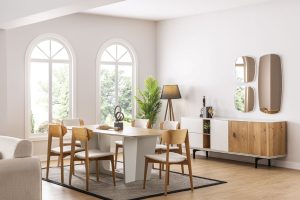
The dining table for your Irish Home is the single most-used piece of furniture in most Irish homes. It’s where dinner happens, where homework gets done, where the laptop ends up, and where the friend who “just popped in for a cup of tea” stays for two hours.
So it’s worth getting right. After three generations in the furniture trade, here’s what we’d tell our own family if they were buying one tomorrow.
Start with size, not style
Before you fall in love with a finish, measure the room.
The rule we use on the shop floor is to leave at least 90 cm of clear space between the edge of the table and the nearest wall, cabinet, or radiator. That’s the minimum a person needs to pull a chair out and sit down comfortably. Less than that and dinner becomes an obstacle course.
For seating, a good guide is 0 cm of table edge per person. So:
– A 120 cm table seats four people comfortably.
– A 150 cm table seats six in a squeeze, four with elbow room.
– A 180 cm table is a proper six-seater with room for serving dishes.
– A 200 cm+ table seats eight and is what you want if Sunday dinner is a regular event.
If your space is tight but you still entertain, an extending table is worth the small extra cost. The mechanisms have come a long way, and most modern ones lock solid once extended.
Round, oval, or rectangular?
Rectangular tables fit most Irish kitchens because most Irish kitchens are rectangular — they sit nicely against a wall and use the space efficiently.
Round tables are better for conversation (no one is stuck at the end) and feel less formal, but they take up more floor space for the same number of seats. They suit kitchens where you want a softer feel.
Oval tables are the compromise — the seating capacity of a rectangle with the conversational warmth of a round. They’re our quiet favourite for medium-sized rooms.
Material: what actually lasts
For a table that will still be in your home in twenty years:
– Solid hardwood (oak, ash, walnut) is the gold standard. Heavy, repairable, ages beautifully. Costs more upfront but works out cheaper per year of use.
– Solid wood with a quality veneer top is a sensible middle ground if the budget is tight. Just make sure the veneer is at least 1 mm thick — anything less and chips become impossible to repair.
– Engineered wood (MDF with a laminate finish) is fine for a starter table or a holiday home, but won’t survive years of family use. Watermarks are permanent, and edges chip easily.
In the damp Irish climate, solid wood with a wax or oil finish generally outperforms a heavily lacquered finish. When the lacquer cracks, water gets in, and you can’t fix it. Wax and oil can be reapplied at home in twenty minutes.
Three quick quality checks before you buy
When you’re looking at a table — online or in person — these three things tell you everything:
1. Lift one corner. A well-made table feels solid and lifts as one piece. If anything wobbles or creaks, the joinery isn’t right.
2. Look underneath. Good tables have proper corner blocks or stretchers reinforcing the legs. Cheap tables have none.
3. Run your hand along the underside of the top. It should feel as smooth as the top surface. Cheap manufacturers cut corners on the bits you can’t see.
One last thought
Don’t buy a table for the home you wish you had. Buy it for the home you actually live in. If you’ve got young kids, get something you don’t have to panic about when juice gets spilt. If you live alone but love hosting, get the extended one. The “perfect” table is the one that suits how you actually use the room.
Need a hand picking? Drop us an email at hello@atlanticfurniture.ie — we’ll happily talk you through our recommendations for your space.